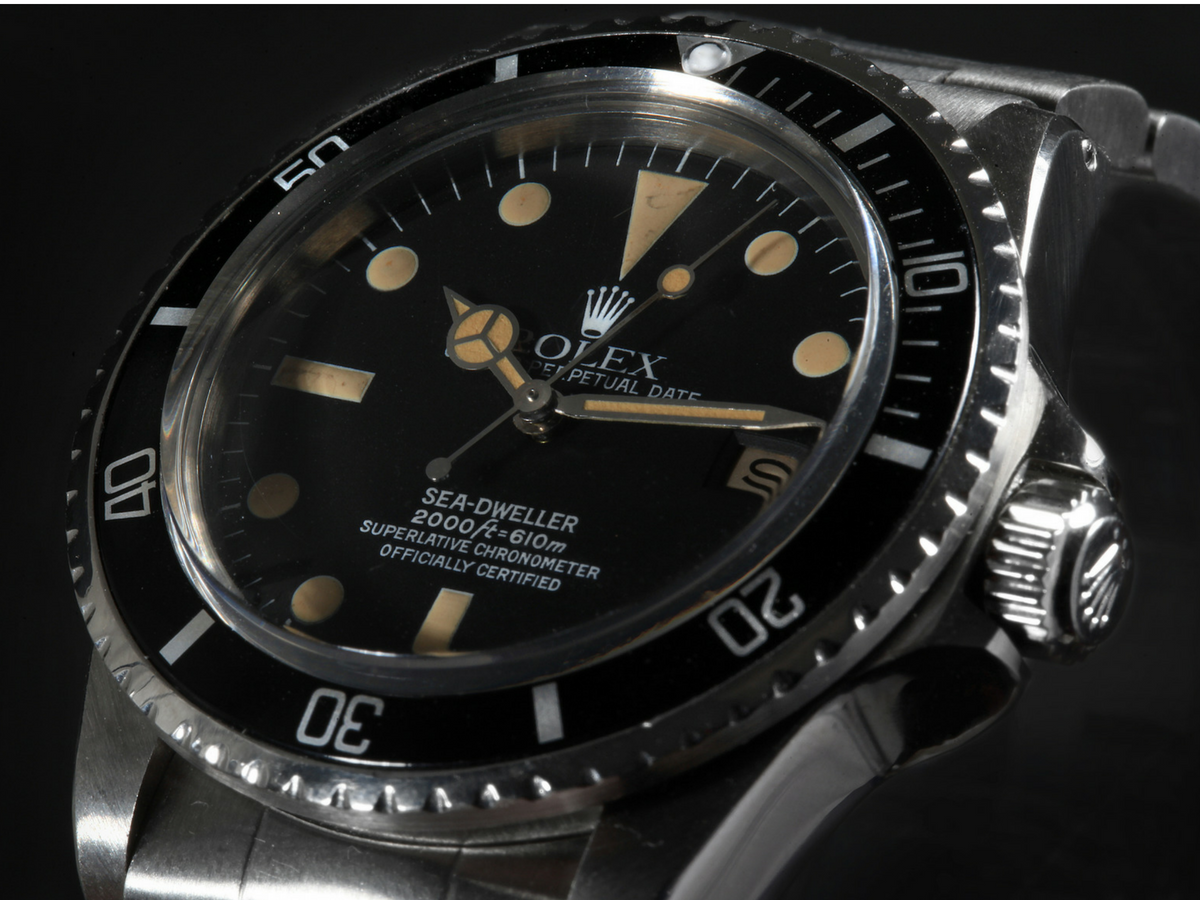
When it was first introduced, the Rolex Sea-Dweller wasn’t as popular as it is today. It was made for a very specific purpose – to go deeper than the average dive watch and to be a reliable tool for dedicated saturation divers.
But for this alone, it holds its own among greats like the Datejust, Submariner, and the Day-Date; and with a new model released on its 50th year, it looks like it’s going to be around for long, long time. br
Here’s a look at the Sea-Dweller’s beginnings and its most defining models: br
While the the Submariner, Rolex’s first dive watch, could reach an impressive 200 meters / 660 feet, a more technologically capable watch was needed for hardcore, saturation diving and staying underwater for extended periods of time.
As saturation diving requires the use of helium with the breathing gas, helium particles tend to accumulate within the case of a diving watch, thereby blowing the plexiglass off during decompression. Rolex tried to solve this issue by testing prototypes that had helium escape valves – a way to safely depressurize the watch as it reaches sea level.
These prototypes were called ‘Sea-Dwellers‘, given the long periods they spend underwater. And so, the Rolex Sea-Dweller‘s story began in 1967.
br
br
Key Models of the Sea-Dweller There have been many innovations and deeper depth ratings for the Sea-Dweller in its 50 year existence. Here are the major ones, in 5 watches: br
br
Ref 1665 | ‘Double Red’ (1967-1977) This was the very first production of the Sea-Dweller, and was named so because of the two red lines on its dial.
br
There have been prototypes before this (called ‘Single Red’ as they have only one line of red text), but the Double Red was the first production to have the patented helium escape valve.
br
br
Ref 1665 | ‘Great White’ (1977-1983) The Great White keeps most of the features of the Double Red: same case, same water resistance – but this time, the two red lines have been changed to white.
br
This trait aside, it’s highly coveted by collectors because it was the last Sea-Dweller to use the plexiglass crystal, which is a defining feature of a vintage watch.
br
br
Ref 16660 | ‘Triple Six’ (1978-1989) This is considered by many to be the start of the “modern” Sea-Dwellers, mainly because it now features the sapphire crystal.
br
But more than this, it improved several crucial features: a bigger case, a larger helium valve, all of which led to an increased water resistance of 4,000 feet or 1,220 meters – twice than the previous models.
Ref 116660 | ‘Deepsea’ (2008 – present) Two decades after, Rolex took the Sea-Dweller to another level with the Deepsea, whose water resistance was tripled to 12,800 feet / 3,990 meters.
br
The long wait led to a number of technical feats, including a 55mm thick sapphire crystal to support underwater pressure, a Ringlock system that manages the watch’s thickness to 18mm, and of course, Rolex’s new Cerachrom bezel and Chromalight lume.
Pictured here is the special edition Deepsea, or the D-Blue edition, which was made to commemorate director James Cameron’s expedition to the Mariana Trench. Cameron was accompanied by a custom 51mm Deepsea Sea-Dweller, that dove 10,908 meters below sea.
br
br
Ref 126600 | 50th Anniversary Sea-Dweller A Sea-Dweller fan would spot this model’s difference immediately: the larger 43mm case and thicker 22mm lug size, and of course, the Cyclops lens over the date. It became the first Sea-Dweller to feature the Cyclops; and it also paid homage to the very first prototypes, with its single red line.
br
It seems all these improvements were to help the Rolex Sea-Dweller cater to those who want a larger case, all while tempering the advanced features of the Deepsea.
With a 50-year history, the Rolex Sea-Dweller is not only a reliable and steadfast tool watch, it is also emblematic of Rolex’s history of exploration and adventure.
PHOTO CREDITS: Susan White, Superintendent of the Marianas Trench Marine National Monument, and director and explorer James Cameron, US Fish and Wildlife Service
When you think of a Patek Philippe complications timepiece, you might immediately picture a conservative, hyper-traditional watch meant strictly for black-tie affairs. But in 2019, when the manufacture introduced the Ref. 5172G to replace the beloved (yet austere) Ref. 5170, they didn’t just update a classic—they rewrote the playbook. Crafted in 18k white gold and defined by…
For decades, the two-tone bezel has been the ultimate calling card of the Rolex GMT-Master. Originally born out of sheer utility in 1955 to help Pan Am pilots differentiate between day and night hours, the split-color insert has evolved into one of the most recognizable design elements in luxury horology. But while vintage models relied…
Cartier isn’t just a jeweler; it is the “Jeweler of Kings and the King of Jewelers.” For over a century, the Parisian maison has defined what it means to wear a luxury timepiece, leaning heavily on its rich French heritage and legacy of exquisite design. For watch collectors and fashion enthusiasts alike, Cartier represents the…
For years, the watch world has been obsessed with steel sports watches and monochromatic dials. Standard-issue stainless steel with black or silver dials dominated waiting lists, auction houses, and social media feeds alike. But a quiet revolution is happening on the wrists of those in the know. The combination of warm, 18k rose gold and…
Contact Us
Have a question or something to share? Send us a message and our team will be happy to help.



![Rolex Sea-Dweller: Its Most Defining Models | SwissWatchExpo [Rolex Watches]](https://i.ytimg.com/vi/4P3tDSJY8Xg/sddefault.jpg)