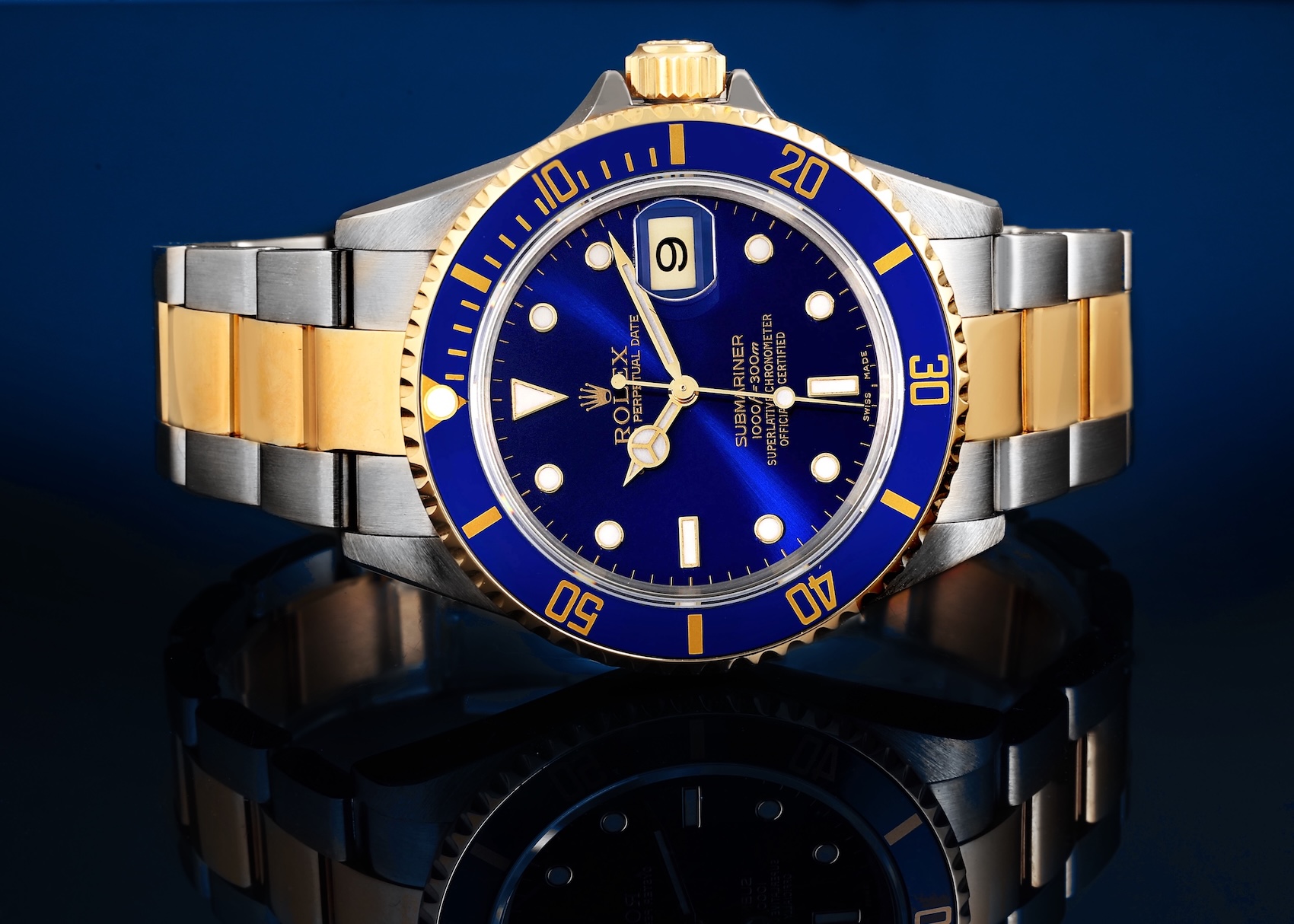
When assessing the landscape of vintage and neo-vintage Rolex, few references capture the bridge between pure utilitarian function and unapologetic luxury quite like the Rolex Submariner Reference 16613.
Produced over a remarkable 21-year run from 1988 until 2009, the 16613 defined an era for the Crown. It took the world’s most recognizable dive watch and rendered it in Rolesor—Rolex’s signature combination of 904L stainless steel and 18k yellow gold. Today, as collectors look for value outside of modern steel pieces, the 16613 stands as a masterclass in pre-ceramic design.
Whether you are navigating the current secondary market or simply studying Rolex history, here is everything you need to know about the entire 16613 reference family.

The Evolution of the 16613 Case and Bracelet
The 16613 succeeded the transitional reference 16803, bringing with it vital mechanical updates while retaining the classic, elegant proportions of old-school Rolex.
Because it was produced for over two decades, the 16613 underwent several incremental updates that are crucial for collectors to identify:
The Pre-Maxi Case: Unlike modern Submariners with their broader lugs and bulkier profiles, the 16613 features the classic 40mm Oyster case with sweeping, tapered lugs. It offers a much slimmer, more refined wrist presence.
Lug Holes: Early models featured pierced lug holes, making bracelet changes a breeze. Rolex began phasing these out around 2003 (starting with the Y-serial numbers), resulting in a cleaner, unbroken case flank.

Bracelet Evolution: Early iterations featured hollow end links (HEL) and stamped clasps. By 2000, Rolex upgraded the two-tone Oyster bracelet to solid end links (SEL), vastly improving the bracelet’s durability and reducing the notorious “stretch” associated with older models. Later models also introduced a gold strip running through the clasp for a more cohesive look.
Luminescence: A 16613 timeline can be traced by its dial glow. Models from 1988 to 1997 use Tritium (marked T<25), which ages into warm, creamy patinas. Rolex then briefly used Luminova (1998-1999) before settling on Super-LumiNova for the remainder of the production run.
Shop Rolex Submariner Steel and Yellow Gold Watches
Inside the Market: While stainless steel is often called the ‘king’ of sports watches, the 16613 is a powerhouse in its own right. Over the last three quarters, it has consistently ranked as our second most-popular Submariner model, second only to the classic 16610.
Dial Variations: Beyond the “Bluesy”
While the blue sunburst dial is undeniably famous, the 16613 was offered in several distinct configurations, each appealing to a different type of collector.
1. The Black Dial (16613LN)
Often overshadowed by its blue sibling, the 16613LN (Lunette Noir) is the epitome of understated luxury. The glossy black dial and matching black aluminum bezel insert provide a stark, highly legible contrast to the 18k yellow gold hands, hour markers, and bezel ring. It is an incredibly versatile aesthetic that feels slightly more formal and grounded.
To truly appreciate the contrast between the inky black dial and the 18k yellow gold, you have to see it in motion. Check out this closer look from our showroom:
2. The Blue Sunburst Dial (16613LB / “Bluesy”)
The most recognizable iteration. Rolex’s sunburst finishing allows the blue to shift dynamically from bright marine to deep navy depending on the lighting.
Collector’s Note: On early Tritium models from the 1990s, UV exposure and manufacturing variances caused some of these blue dials to degrade into a striking, highly sought-after purple hue, commanding a premium on the secondary market.
3. The “Serti” Dials (The Sultan)
For the ultimate expression of 1990s opulence, Rolex offered the 16613 with “Serti” dials (from the French sertir, meaning to set). Available in slate, champagne, and silver, these dials replaced standard luminescent plots with factory-set precious gems—typically eight brilliant round diamonds and three baguette-cut sapphires (or occasionally rubies) at 6, 9, and 12 o’clock.
The way light plays off the diamond and sapphire markers on a Serti dial is something still photography rarely captures perfectly. See the stunning detail of a silver Serti dial in the video below:
The Engine: Caliber 3135
The introduction of the 16613 in 1988 coincided with the debut of one of the greatest movements Rolex has ever produced: the Caliber 3135.
This self-winding, COSC-certified chronometer is the definition of a workhorse. Beating at 28,800 vibrations per hour, it offers a 48-hour power reserve and a quick-set date function. Later in its production run, the movement was upgraded with Rolex’s Parachrom hairspring, granting it superior resistance to shocks and temperature swings. That Rolex utilized the Caliber 3135 for over 30 years across multiple models is a testament to its bulletproof reliability.
2026 Market Trends: Why the 16613 is a Smart Acquisition
In the current 2026 market context, the 16613 occupies a highly strategic position.
Modern, six-digit Submariners (like the 116613 and 126613) feature scratch-resistant Cerachrom bezels and solid-gold center links, but they also come with significantly higher secondary market premiums. Conversely, the 16613 offers the unmistakable prestige of a two-tone Submariner, but its aluminum bezel insert provides a warmth and vintage character that ceramic simply cannot replicate.
Furthermore, a well-maintained 16613 can frequently be acquired for less than the cost of a modern stainless steel Submariner. For collectors seeking a watch with rich provenance, exceptional mechanical reliability, and undeniable wrist presence, this 21-year reference remains one of horology’s most compelling buys.